
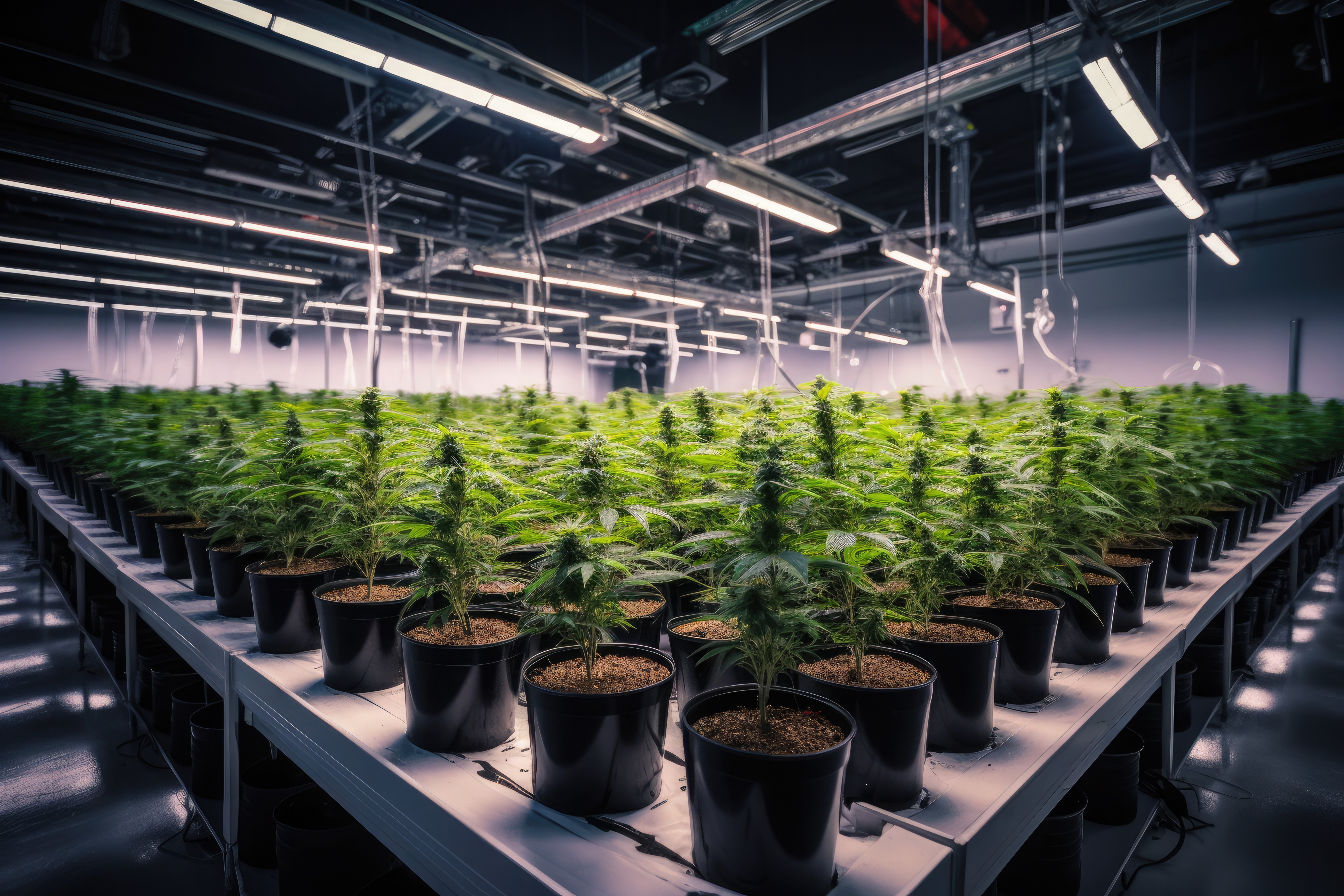
Commercial indoor growers use carbon dioxide enrichment to support photosynthesis and plant growth, but there is no single CO2 level that works for every facility. The amount a grow room needs depends on factors such as room size, plant stage, light intensity, ventilation, environmental controls, and the delivery method. These variables all affect how CO2 is used and how often it needs to be added.
A well-planned enrichment system treats CO2 as one part of the grow environment. Florida CO2 helps indoor cultivation facilities plan and manage CO2 enrichment based on room size, operating conditions, and production needs. That includes the supply, storage, controls, monitoring, installation, and delivery needed to support the system.
Why CO2 Matters in a Grow Room
Carbon dioxide is one of the necessary resources plants use during photosynthesis, along with light and water. Cannabis plants take in CO2 through their leaves and use that carbon as part of the process that supports plant growth. In an enclosed grow room, naturally available CO2 may not always match the demands of an intensive cultivation program.
Adding CO2 can support greater photosynthetic activity when lighting, temperature, irrigation, nutrients, and other environmental conditions are also managed well. More CO2 does not automatically mean more growth. If light intensity or another major input is limiting the crop, extra CO2 may provide little benefit.
CO2 enrichment works best when it is coordinated with the rest of the grow environment. Cannabis plants primarily use supplemental CO2 during active photosynthesis, so growers typically add it during the light cycle. When lighting, temperature, nutrients, irrigation, and other growing conditions are properly managed, CO2 enrichment can support stronger plant growth and greater production potential.
Recommended CO2 Levels for Indoor Grow Rooms
CO2 concentration is measured in parts per million, or ppm. Ambient air provides a baseline, while an enriched grow room operates above that background level. The useful target changes with the crop stage, lighting level, room design, and cultivation strategy.
Early growth generally needs less supplemental CO2 than later stages. Vegetative-stage enrichment is often managed at moderately higher concentrations, while flowering rooms may use higher targets when strong lighting and environmental controls can support the added demand. Many enrichment programs operate within roughly the 1,200 to 1,500 ppm range in flower rooms and 700-800pm in veg rooms, but that range should be treated as a planning reference rather than a universal prescription for every crop or facility.
Growers also need to separate plant targets from employee exposure limits. OSHA lists a permissible exposure limit for carbon dioxide of 5,000 ppm as an 8-hour time-weighted average. NIOSH also recommends 5,000 ppm as a time-weighted average and lists higher short-term and immediately dangerous concentrations. Crop-control settings should never replace a facility’s worker-safety monitoring and response procedures.
How to Calculate How Much CO2 a Grow Room Needs
A basic calculation starts with room volume. Multiply room length by width by height to get cubic feet. Then determine the increase in CO2 concentration needed to move from the starting level to the target level.
For a simplified one-time dose, multiply room volume by the desired ppm increase, then divide by 1,000,000. The result is the approximate cubic feet of pure CO2 needed to create that concentration increase if the gas mixes evenly and none escapes. To estimate dose time, divide the required CO2 volume by the delivery flow rate and convert the result to minutes.
That calculation is only a starting point. Real-world use is affected by air exchange, leaks, exhaust cycles, plant uptake, room pressure, dosing frequency, and how tightly the space is controlled. A ventilated room can use substantially more CO2 because enriched air leaves the space and must be replaced.
For commercial planning, growers should also compare the calculated dose with the way the grow room actually cycles air during a normal day. Door openings, scheduled exhaust, pressure changes, and HVAC operation can all change consumption. Tracking cylinder or bulk usage alongside controller data can help a facility build a more realistic demand profile for future delivery and storage decisions.
Example CO2 Calculation
Consider a 10-by-10-foot commercial room with an 8-foot ceiling. The room volume is 800 cubic feet. If the starting concentration is 400 ppm and the target is 1,200 ppm, the increase is 800 ppm. The simplified calculation is 800 × 800 ÷ 1,000,000, which equals about 0.64 cubic feet of CO2, or about 18.1 liters, for one theoretical dose before accounting for losses.
A 4-by-4-foot grow tent with an 8-foot height has 128 cubic feet of volume. Using the same 800 ppm increase, the simplified dose is about 0.10 cubic feet, or about 2.9 liters, before ventilation and leakage are considered. Commercial system sizing should use actual room conditions and operating schedules rather than relying on a one-time calculation alone.
Ways to Add CO2 to a Grow Room
Bottled CO2
Bottled CO2 is a controlled option for small grow rooms whose demand fits cylinder-based supply. Cylinders can be paired with the proper regulator, solenoid, controller, and distribution equipment to manage dosing. For facilities using moderate amounts of gas, adding CO2 from cylinders can also make delivery and storage planning straightforward.
Bulk and Micro-Bulk CO2
Medium to Larger operations with steady consumption may be better suited to bulk or micro-bulk storage. These systems can reduce frequent cylinder changeouts and support scheduled CO2 delivery. Depending on the facility, the setup may include storage tanks, piping, manifolds, and controls designed around the grow areas they serve. Site design, equipment requirements, and applicable permitting or code requirements should be reviewed before installation.
CO2 Generators and Small-Scale Sources
Some growers use combustion-based CO2 generators that burn propane or natural gas. These systems produce CO2 but also add heat and introduce several combustion-related operating concerns, so ventilation, equipment condition, and environmental controls need careful planning.
Slow-release bags and fermentation are also used in some small growing spaces. Dry ice may be used as a temporary CO2 source in small, limited situations. These methods generally offer less control and scalability than a designed commercial enrichment system, which makes them a poor fit for many larger operations.
CO2 Enrichment Equipment and Grow Room Controls
A commercial system needs more than a CO2 source. Common components can include a regulator, solenoid or control valve, CO2 controller, flow-control equipment, pressure gauges where appropriate, distribution piping or tubing, sensors, alarms, and environmental controls. The exact equipment depends on the supply method and room design.
Distribution also matters. The system should deliver CO2 in a way that supports even mixing across the grow room instead of creating isolated high or low readings. Fan placement, canopy density, supply points, and sensor locations can affect what the controller sees and how the gas moves through the space.
Controllers and NDIR-based CO2 sensors can help a facility measure conditions and manage adding CO2 based on a set point. Alarm and shutdown functions may also be integrated into the system. Equipment should be selected for the intended application and installed by qualified professionals who understand the cultivation environment and the CO2 supply system.
Coordinating CO2 With Lighting, Ventilation, and Climate Control
CO2 enrichment works best as part of a controlled grow environment. Strong lighting gives cannabis plants the energy needed to make use of higher CO2 concentrations. Temperature, humidity, irrigation, and nutrient management also influence plant growth and should be managed as part of the same environmental strategy.
Closed or semi-closed rooms generally retain enriched air better than spaces with constant exhaust. Frequent ventilation can remove CO2 soon after it is released, increasing consumption and reducing dosing efficiency. Adding CO2 while an exhaust system is rapidly removing room air can waste gas unless the controls are coordinated.
Air conditioning and dehumidification also need to support enriched-room operation. Good air circulation helps distribute CO2 through the plant canopy. Because plants primarily use supplemental CO2 during active photosynthesis, dosing is typically coordinated with the light cycle. Automated controls can also coordinate CO2 delivery with ventilation, HVAC, and other equipment based on the facility’s operating plan.
Monitoring CO2 Levels and Protecting Employees
Continuous monitoring gives commercial growers a better view of conditions while adding CO2. Plant-control sensors and worker-safety monitors can serve different purposes, so placement should follow the equipment manufacturer’s guidance and the system design. A crop-control sensor may be positioned near the canopy, while safety-monitor placement should reflect worker exposure and potential accumulation areas.
Facilities may also use alarms, staff notifications, ventilation responses, or automatic shutdown functions when CO2 moves outside defined limits. Employees should know what an alarm means and what procedure to follow. Sensors need routine inspection, cleaning, testing, and calibration according to manufacturer recommendations because contamination and calibration drift can affect readings.
Common CO2 Enrichment Mistakes
One common mistake is adding CO2 before the lighting and environmental controls are ready to support it. Other problems include running enrichment while exhaust removes the gas, allowing poor air circulation, relying on inaccurate sensors, or using more CO2 than the cultivation strategy requires.
Combustion generators also require attention to heat, equipment condition, and combustion-related risks. If cannabis plants show unexpected stress, growers should review the full environment instead of assuming CO2 is the only cause. Light, temperature, humidity, irrigation, nutrients, airflow, and CO2 all interact inside a controlled room.
When Does Commercial CO2 Enrichment Make Sense?
Commercial enrichment makes the most sense after the basic grow environment is under control. Before investing in adding CO2, operators should evaluate lighting capacity, ventilation, HVAC, room sealing, facility scale, expected consumption, labor for cylinder changes, and production goals.
Cylinders can be practical for smaller operations or lower-demand rooms. Higher-volume facilities may benefit from bulk storage and scheduled delivery. Costs also vary with equipment, installation, consumption, labor, and facility design, so a useful financial review should be based on the actual site rather than a generic ROI estimate.
Get Commercial Grow Room CO2 Support From Florida CO2
Florida CO2 has served South Florida businesses for more than 60 years and works with indoor cultivation operations across the state. The company provides CO2 supply and delivery, cylinder and bulk storage options, enrichment systems, monitoring and safety technology, and professional installation and service.
If your facility is planning a new enrichment system, reviewing current CO2 use, or considering a move from cylinders to bulk storage, Florida CO2 can help assess the site and develop a supply and delivery approach that fits the operation. Contact Florida CO2 to request a quote or discuss your grow room needs.